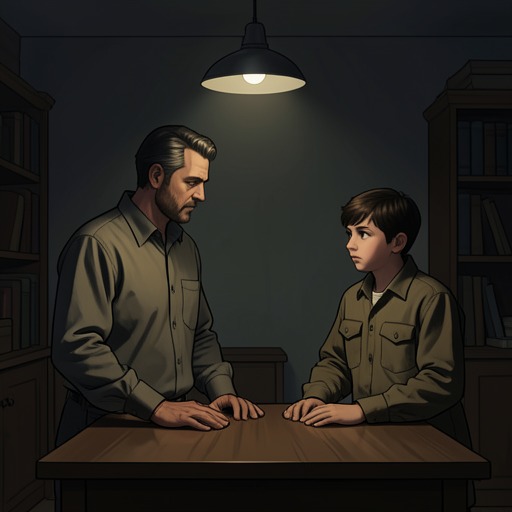
Tooru's father
Even If This Love Disappears From the World TonightTooru's father is a widowed car-factory worker and lifelong aspiring novelist whose grief has narrowed his ambitions without extinguishing them. In the Kamiya household, he depends on Tooru for much of the daily work, yet their meals, his writing, and the family altar show a relationship sustained by habit and affection. Later, his place among those who help Maori graduate and resume art classes makes his care part of a larger network of support, even as the story gives him little direct speech in its final reckoning with loss.
Identity and Background
He lives with Tooru in a public housing complex and works on the assembly line at a nearby car factory. He does not work nights, a choice associated with lower pay. Tooru handles most of the housework; the family’s modest means are reflected in the importance placed on keeping clothes presentable and sanitary. The domestic order is also an inheritance from Tooru’s sister, whose routines Tooru tries to preserve after she leaves.
Tooru’s mother died when he was little. He remembers his father as having had the sort of ambition expected of a father while she was alive, but says that this ambition disappeared afterward. Relatives likewise say that his father changed following her death. The narrative presents grief through this alteration in his life rather than through a detailed account of his mourning: loss becomes visible in the gap between the person he seemed to be and the ambitions he no longer pursues openly.
Work, Writing, and Household Life
Writing novels remains his hobby and his form of entertainment, and Tooru describes it as perhaps the whole point of his life. He has been writing since before Tooru was born, though he has never won a prize. His dream is to support himself as a novelist, and he continues working toward that possibility: at one point he is preparing a submission for the Literary World New Author Prize, whose deadline is approaching.
That devotion has a practical cost at home. Tooru says his father neglects household chores because of his writing, but finds it difficult to scold him for pursuing a dream he has held for so long. Their arrangement is therefore unequal but not portrayed as simple resentment: Tooru shoulders the work, while recognizing the persistence and vulnerability involved in his father’s ambition.
Their domestic exchanges are marked by ordinary familiarity. Tooru cooks the household’s usual Wednesday-night curry and tells his father that he is seeing someone. The father’s widened eyes register surprise at the dutiful announcement. Tooru has shared only the basic account, keeping private that the relationship is not genuine, but the father responds to the news as a meaningful change in his son’s life.
Family Relationships and Grief
After dinner, the father finishes his curry and rice, makes a sound of appreciation, and goes to the room beside the living room. There, in front of the simple family altar he has made space for in their small home, he tells Tooru’s dead mother that Tooru has a girlfriend. He says he had worried because Tooru never talked about girls and that the news is a relief. Tooru protests that he should stop saying strange things to his mother, a response that mixes embarrassment with the intimacy of a family ritual.
The altar scene shows that his wife remains part of the household’s emotional life. He addresses her in the immediate language of family updates, as if the news of their son belongs with her; the story does not suggest that this ritual resolves his grief. Instead, it sits alongside Tooru’s account of how his father changed after her death, making remembrance a recurring domestic practice rather than a dramatic confession.
Tooru also takes after his father in a life organized around writing, though he has abandoned his own writing by the time the story later addresses his unrealized ambitions. The supplied episodes establish the father’s sustained authorship and Tooru’s hesitation to reproach him, but do not show a direct confrontation between them about the father’s career or a resolution of that tension.
Care and Later Consequences
The family’s care work extends beyond chores. After Maori’s accident and the onset of her anterograde amnesia, her parents and Izumi support her through the daily work of living with memory loss. Her written records let her understand each morning what has happened and what her current circumstances are. Looking back, Maori understands that the devotion and self-sacrifice of those around her helped her graduate from high school and attend art classes several times a week, which she had given up before the accident. Tooru’s father is included in that parental support, although the account does not isolate particular tasks he performs.
The contrast with his earlier household role is meaningful but should not be mistaken for a narrated transformation. Before Maori’s accident, Tooru carries much of the housework because his father neglects it for writing. In Maori’s later account, however, parental devotion forms part of the practical foundation that allows her to continue her education and return to drawing. The novel places domestic dependence and parental care beside each other, showing that the father’s role cannot be reduced to either his chores left undone or his ambitions left unrealized.
The strongest evidence about his character remains indirect: Tooru’s recollections, small family rituals, and Maori’s later recognition of the support she received. The father is neither given a complete independent arc nor shown resolving the disappointments of his life. Instead, he stands within a family shaped by bereavement and constrained means, where care appears in uneven labor, a persistent writing practice, a place kept for the dead, and support that helps the next generation keep moving.